We awoke to a beautiful sunny day. Accuweather predicted that the day would be rainy in Cairns, but sunny in Karunda, our destination for the day. Might seem odd, since Karunda is in the mountains, but I think that the wet weather in Cairns is due to the steep increase in elevation into the mountains which drops the moisture as it rises.
We were among the first to the buffet breakfast, which was OK, and then we headed out to the Esplanade for the start of our walk to the train station. I grabbed a pic of Crystalbrook Riley, our hotel, on the way.

A lot of folks were already out, doing their Esplanade things…
as were the pelicans…
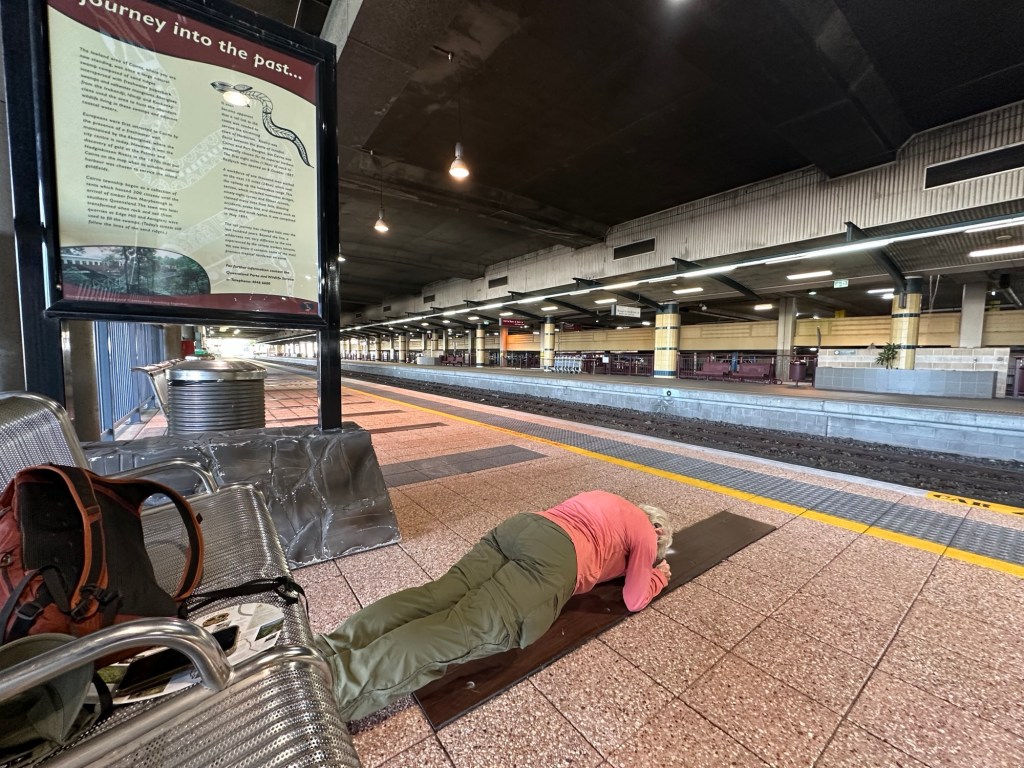
With the help of Google Maps we found the station, a little early, leaving Dana time to get in some planking.
The train made quite an entrance, but it is now electric, so not the deafening roar and hiss of the original steam engines.
We boarded and were soon underway.
The interior of the car is beautifully polished wood, giving it an antique feel and evoking a little of its history. The railway was built to service gold mining between 1886 and 1891: 33k of tracks, three million cubic meters of earth, 15 tunnels, 37 bridges, 150 cuttings…and 32 laborers killed.
We made a huge horseshoe turn…
and started the climb into the mountains.
The couple facing us were very friendly people from Adelaide. I was a little envious of the folks sitting in the single facing seats on the opposite side of the car until it became clear that all of the views were on our side.
We came to the first bridge – over a waterfall…
the ride quickly earning the label of “scenic” – often used more for hype than to inform.
There were views of the coastal plain as we climbed…
.

a glimpse of the Barron River…
and then a stop at Barron Falls…
where, with all of the other tourists, I took a pic of our train from an overpass.
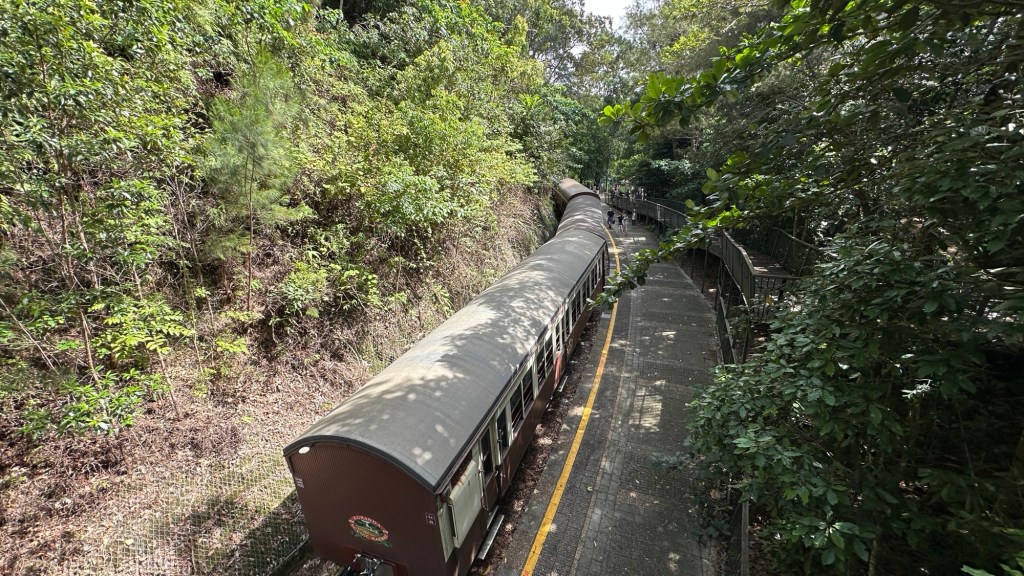
Note the “cutting” the train is sitting in, one of the 150 on the route, which, along with the 15 tunnels (not shown – unphotogenic and thankfully uneventful), create a mind-boggling spectacle of countless dynamite explosions (no estimate available).
Seeing in person the steep slopes, and having experienced the heavy rains and flooding that likely plagued the project, one cannot grasp how it was successfully completed. And that’s without factoring in the brutal heat, humidity, and malaria. A tragic irony: the gold petered out, and malaria devastated the town that grew up around the terminus.The good news: Karunda became, and has for many years been, a top tourist attraction mainly due to the preservation of the train.
The ride ended in the historic Kuranda station.
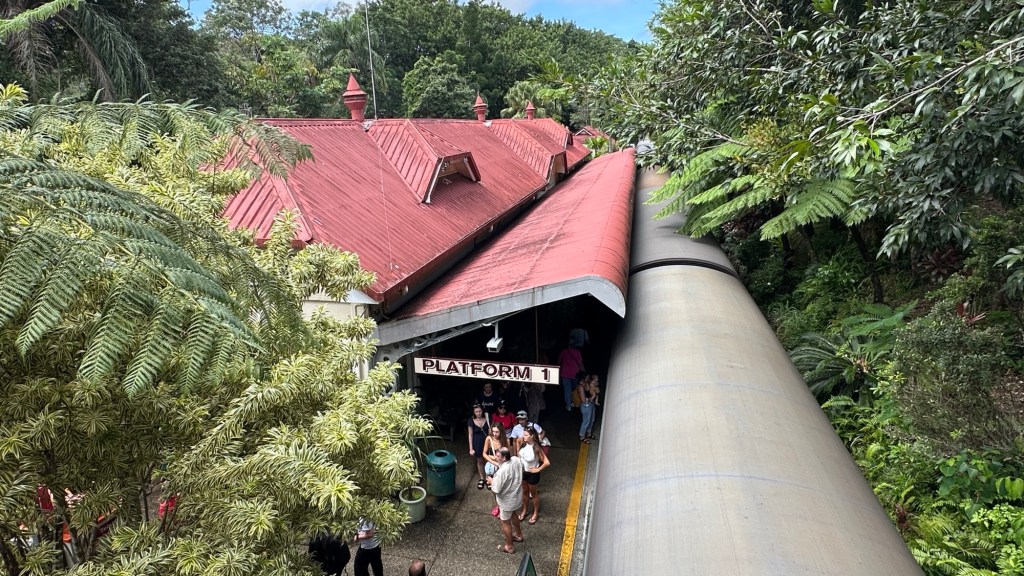

With the other passengers we trooped up into the town, and then directly into the Visitor Center, where we got maps and directions for the sites of most interest to us: butterfly aviary, birdland,and koala camp.
The whole town is an unapologetic tourist trap, with wall-to-wall shops of every kind, restaurants, coffee bars, bars, liquor stores, sweet shops – every imaginable way to make an Australian buck, and we had to weave our way through them at quite some length to get to what we wanted to see. The three we chose were not on any purist naturalist list, but maybe came the closest to it. They did provide some nice photo ops… and we were (in a way) honoring those who sacrificed to make the Railway work.
Starting at the butterfly aviary, we were disappointed that they did not have the star species: the Ulysses, but we did get to walk through and experience the others – not that many species compared to other such places we’ve seen, but still pleasant.
But there was a star of the show, so clearly a diva that the locals have claimed it as their own…

Like a true diva, it knew how to capture and hold an audience.
even adding a pas de deux with a partner.
From the butterflies we moved directly to the birds, for some really close encounters. First, the less colorful…
and then…
Then another Diva…
that was downright coquettish…
and flew right in my face.
And the big kid on the block was right out of Jurassic Park…
We took a break for a mango coconut smoothie – well I did, Dana insisted on skipping lunch – it’s all she’d let me have without complaining, and then we went off for a hike on the village circuit trail – a paved/boardwalk/bridged path that went through the rainforest…
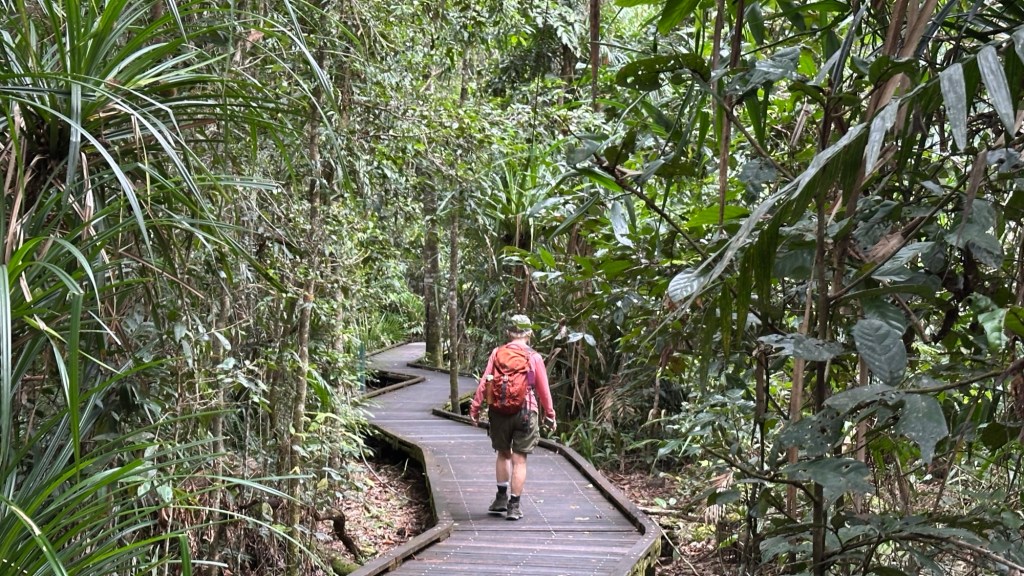

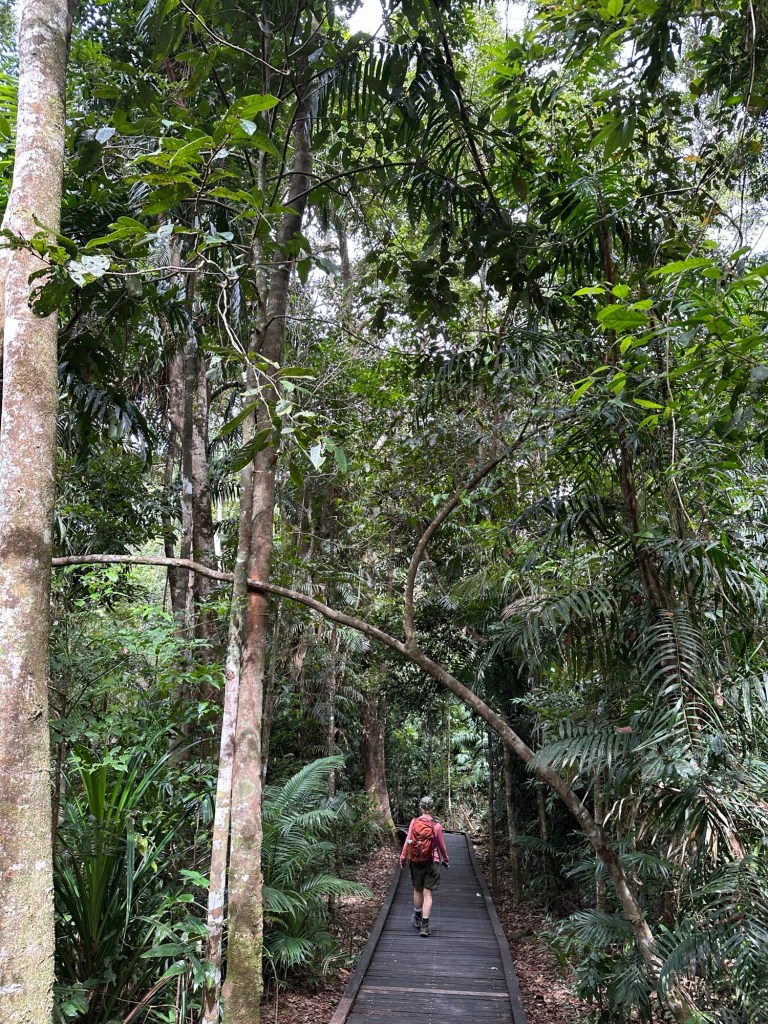
across a creek…

and down to the Barron River…

where we stopped for a little rest in a paper-bark tree grove (amazing stuff – I peeled five or six paper-thin layers off of one very thin piece of it)…
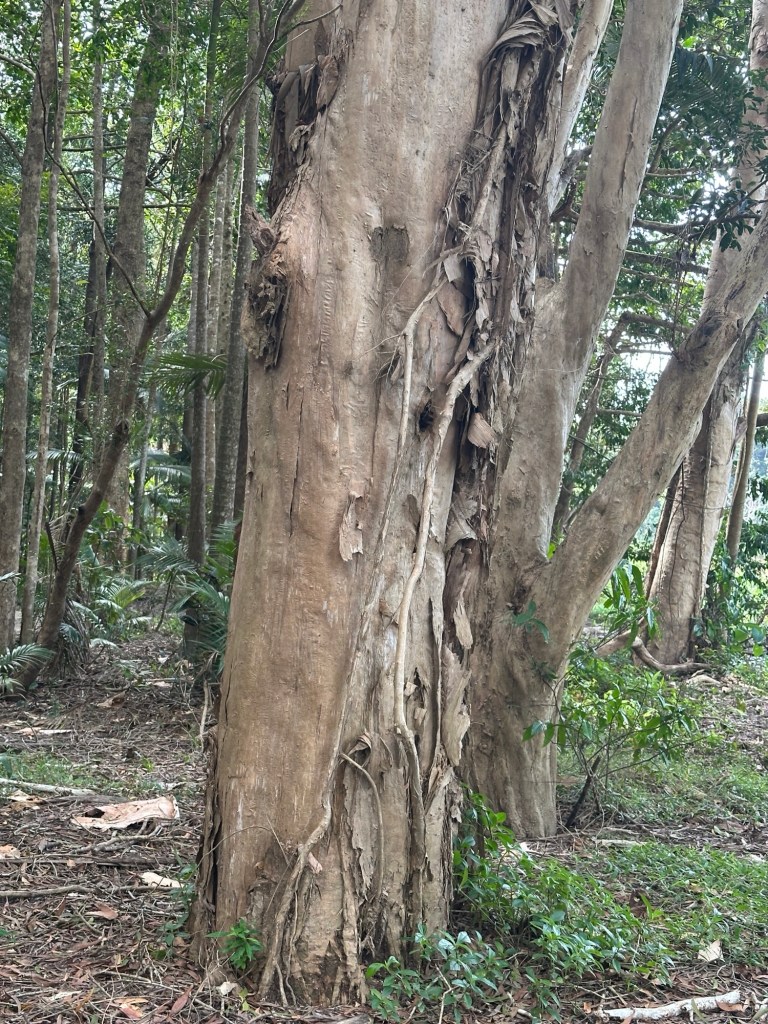

before turning up a stairway to the Kuranda Sky Rail, for the ride back down to Cairns.
The views, and the experience, were extraordinary.
The length was a complete surprise. I hadn’t checked the geography but had assumed it was a short cut. At 4.5 miles, it’s the longest gondola cableway in the world. Wondering about the ecological footprint, I thought the towers instead looked like they were magically dropped into place in the rainforest. They were – sort of.
From the web: “There’s quite a story behind its construction. Due to it operating above a World Heritage-protected national park, there was no access to the forest by road to build the towers supporting the cableway. Construction workers and engineers had to hike in and out each day wearing protective gear over their shoes so they did not damage such a divine environment.The material for the towers had to be dropped in piece by piece by helicopters! So you can rest assured that no part of the Wet Tropics World Heritage Rainforest was hurt in the process.”
As may be evident from the videos, there was not a flat stretch in the whole 4.5 miles (except for the bottom station), so everything had to be constructed on steeply sloping ground.
We got very lucky with a cab at the entrance, and were immediately whisked back to the hotel. We had an early dinner at the hotel and fought off sleep for a while, but since we had a 4am pickup for our flight to Port Moresby we crashed a little after 8.
 Dana and Roger Travels